The Impact of Airplane Contrails on Global Warming

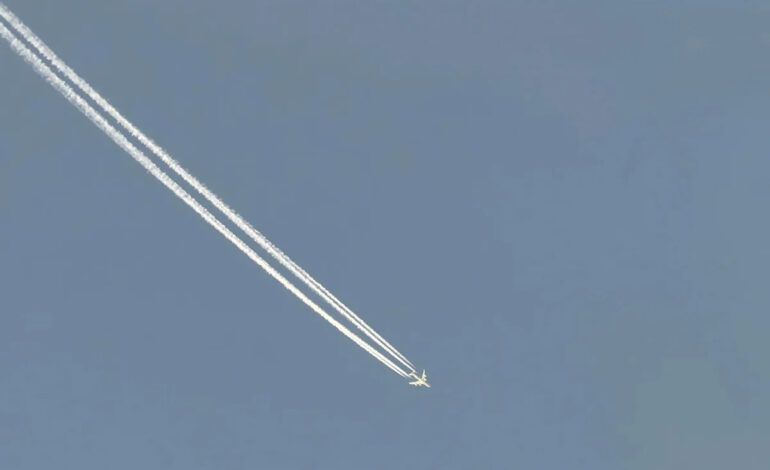
Airplane ‘streaks’—known as contrails—form from condensation trails left by aircraft. While seemingly harmless, these contrails play a significant role in global warming by trapping heat and altering the atmospheric balance. This article delves into how contrails are more than just a visual phenomenon—they are active participants in climate change.
Understanding Contrails
Contrails are formed when the water vapor emitted by aircraft engines condenses and freezes into ice crystals under specific atmospheric conditions. These line-shaped clouds reflect and absorb heat from the Earth’s surface, impacting climate dynamics.
The Science Behind Heat Trapping
Contrails contribute to the greenhouse effect by trapping longwave radiation. This effect is exacerbated when contrails spread into larger cirrus clouds, further complicating the interplay between the Earth’s surface temperature and solar energy.
The Global Environmental Impact
Globally, contrails contribute a substantial share of aviation’s climate impact. Studies suggest contrails could cause more warming than CO2 emissions from aircraft. The aircraft’s altitude, speed, and the atmosphere’s humidity level determine contrail formation and persistence.
Mitigation Strategies
To mitigate the impact, strategies include optimizing flight paths to avoid high humidity areas conducive to contrail formation, developing more efficient engines, and exploring alternative fuels that produce less water vapor.
Future Outlook
With aviation projected to grow, the role of contrails in climate change becomes increasingly critical. Continued research and innovation in aviation technologies and regulatory measures are essential to address this unseen environmental challenge.
Conclusion
Contrails are more than picturesque phenomena; they significantly contribute to global warming by altering atmospheric energy balances. Understanding and addressing their impact is crucial as aviation continues to expand. Effective mitigation measures and technological advancements are essential to reduce the adverse climatic effects stemming from these airplane streaks.